

Published by Laser Digital Asset Management · Authored by Andrea Vianelli
Executive summary
Tokenised markets have crossed from experimentation into regulated market structure, and scale will accrue to products built around a real efficiency or distribution problem and settled in money institutions can treat as final. Distributed tokenised assets (excluding stablecoins) reached US$39.2bn on 16 October 2026, c.6.5x their January 2025 level, while policy action in the US, EU and Hong Kong and at the BIS and FSB has removed much of the legal uncertainty that kept regulated balance sheets out. The binding constraints are now economic and infrastructural: duplicated wrappers that make on-chain products dearer than their traditional equivalents, thin secondary use, and an unresolved settlement-asset question. Originators should design for collateral mobility and ecosystem integration from launch; policymakers should prioritise interoperability standards, 24/7 central bank liquidity and a calibrated path for regulated stablecoin issuers to central bank money.
Key figures
- US$39.2bn: Distributed tokenised RWAs, excl. stablecoins (16 Oct 2026)[1]
- c.6.5x: Growth since January 2025 (c.US$6bn)[2]
- US$365bn: Average daily tokenised repo, Broadridge DLR (Jul 2026)[3]
- c.US$300bn: Stablecoins outstanding, 99% USD-pegged (mid-2026)[14]
A. Momentum: the market and the rulebook have both turned
Scale: from niche to institutional asset class
Tokenised assets have entered a phase of rapid, institution-led growth, anchored by cash-equivalents. Distributed tokenised real-world assets (excluding stablecoins) rose from c.US$6bn in January 2025 to US$21.5bn at the start of 2026 and US$39.2bn on 16 October 2026, an 82% gain year-to-date.[1,2] Tokenised Treasury products lead: the five largest hold c.US$9.9bn.[1] The public-chain figure understates institutional activity. A further US$353bn is recorded on-chain but confined to issuing platforms, and Broadridge’s Distributed Ledger Repo platform alone settled US$8.0tn of repo in July 2026.[1,3]
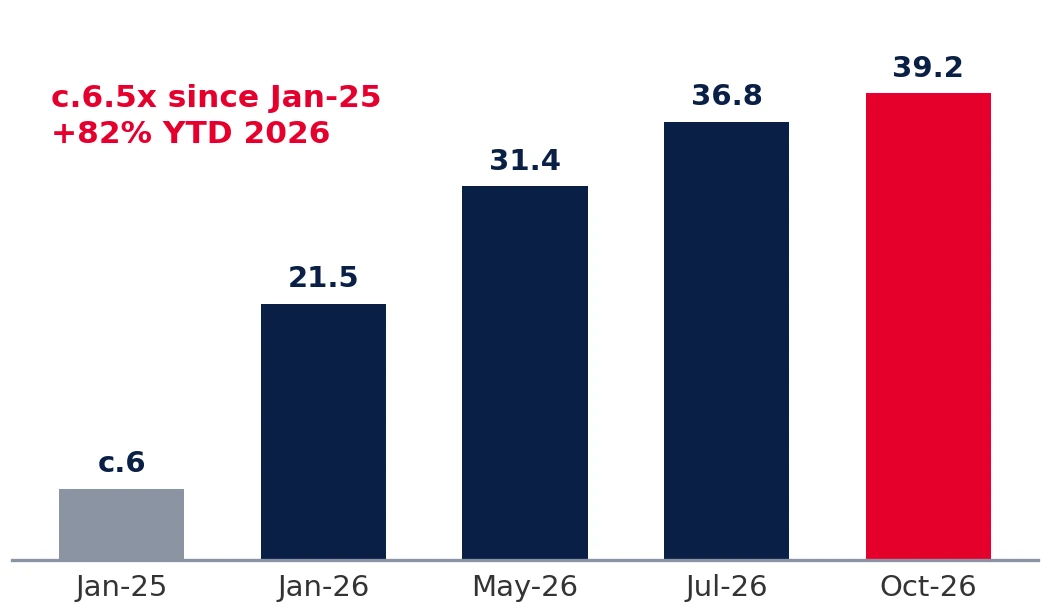
Excl. stablecoins. Source: RWA.xyz; Binance Research; insights4vc.
Policy: from containment to construction
Policymakers have moved from ring-fencing the technology to building legal plumbing for it, closing much of the uncertainty that kept regulated institutions out.
- United States. The GENIUS Act (Pub. L. 119-27, 18 July 2025) created a federal payment-stablecoin regime, effective by January 2027 at the latest, with 1:1 reserves in cash, central bank balances, short-dated Treasuries and similar liquid assets, a ban on issuer-paid interest and holder priority in insolvency.[4] The SEC approved Nasdaq rules allowing securities to trade in tokenised form, with optional token settlement through DTC’s pilot (March 2026), granted an Innovation Exemption for tokenised-securities venues (17 September 2026) and proposed allowing a blockchain to serve as the master securityholder file.[5]
- European Union. MiCAR has applied in full since 30 December 2024. The Eurosystem has accepted marketable assets issued via DLT-based CSD services as collateral since 30 March 2026, and its Pontes service has linked DLT platforms to T2 central bank money since 21 September 2026.[6]
- Hong Kong. The Stablecoins Ordinance (Cap. 656) took effect on 1 August 2025; the HKMA granted the first two issuer licences on 10 April 2026 and plans to move EnsembleTX to round-the-clock operation with wholesale CBDC settlement by around end-2026.[7]
- Supranational. Project Agorá (convened by the BIS and the IIF; seven central banks and 40+ regulated firms in the prototype phase) concluded that tokenising reserves and deposits does not alter their legal character and that settlement finality is achievable in all seven jurisdictions. The G20 finance track (September 2026) looked to the FSB for findings on the cross-border implications of global stablecoin arrangements, and the FSB (October 2026) has turned to cross-border implementation.[8]
Durability is the residual risk: the CLARITY Act failed a Senate procedural vote on 15 September 2026, leaving key US relief in revocable exemptions and staff positions.[5]
B. Economics: value comes from solving a problem
24/7 markets supply the missing use case
The push to continuous markets gives blockchain the problem it has long lacked. The CFTC has consulted on 24/7 derivatives trading and clearing, the SEC approved intraday trading of a tokenised money market fund in February 2026, and DTCC processed its first production trades using tokenised collateral in July 2026.[9] Legacy rails run on business-day cycles, with RTGS cut-offs and weekend gaps; tokenised cash and collateral move when those rails are closed. The IMF observes that standing facilities “designed around business-day cycles are insufficient in a 24/7 tokenized environment”.[10]
Efficiency and distribution: two intertwined drivers
Originators tokenise for efficiency and distribution; investors buy for the same two reasons plus accessibility. Efficiency comes from atomic delivery-versus-payment, fewer reconciliations, programmable servicing and faster collateral turnover. It reaches the investor as better product economics (lower cost, higher net yield) and as utility (24/7 transferability, use as margin or repo collateral). Distribution comes from wallet-based channels, global reach and lower minimums. The drivers compound: a cheaper and more useful token is easier to distribute, and wider distribution deepens the secondary liquidity that makes it useful.
Where the model breaks, and where it works
Many tokenised products cost more and do less than their traditional equivalents because they duplicate layers instead of removing them. Laser Digital estimates all-in premia of c.10–15bps on average for tokenised money market products over comparable institutional share classes (from c.3bps to over 30bps depending on product and share class), and c.50–70bps for tokenised private-markets feeders, where a token platform and feeder vehicle sit on top of the master fund.[11] Utility is equally thin. The ECB finds that around half of the largest tokenised money market funds keep a traditional book-entry register as the legal record, none is fully on-chain, over half rely on third-party transfer agents, and cut-off times persist.[12] The BIS reports that in each of two leading funds, c.90% of holdings sit in four wallets.[13]
The products that have scaled began with the problem. Broadridge’s tokenised repo improves intraday collateral mobility inside existing workflows; the 2024 DTCC–Digital Asset pilot used tokenised Treasuries as margin with legally enforceable control throughout; and EU money market funds that use DLT as the official register, such as Spiko’s EU T-bill fund (US$638m), offer low-minimum access to money market yield without a parallel ledger.[1,3,10,12]
| Dimension | Value-destructive design | Value-accretive design |
|---|---|---|
|
Cost |
Stacked wrappers (feeder, SPV, token platform) add c.50–70bps in private markets |
Native tokenised share class on a single register |
|
Legal record |
Parallel book-entry and DLT ledgers reconciled by third-party agents |
DLT as the official register (e.g. EUTBL, USYC, JTRSY) |
|
Utility |
Held for yield only; holdings concentrated in a handful of wallets |
Eligible as margin and repo collateral (DTCC tokenised collateral; Broadridge DLR) |
|
Access |
Jurisdiction constrained and business-day cut-offs |
Low minimums, 24/7 transfer, intraday redemption/daily payments |
Source: Laser Digital estimates and analysis, drawing on ECB (2026), BIS (2025), IMF (2026), Broadridge (2026), DTCC (2026); see notes 3 and 9–13.
C. Infrastructure: settlement money and interoperability
The settlement-asset question
Institutional scale requires settlement in money that preserves singleness; regulated stablecoins can qualify only by converging on bank-like safeguards. Stablecoins (c.US$300bn, 99% dollar-pegged) are used mainly within crypto-asset markets.[14] Institutions prefer tokenised deposits, which settle at par in central bank money, and tokenised central bank reserves, which are central bank money; the IIF reports that tokenised reserves are “by far” the leading settlement asset for tokenised transactions.[15] BIS analysis holds that private tokenised money can preserve singleness if issuers meet the same standards and enjoy the same safeguards, “including access to the lender of last resort”.[16] Central banks remain cautious, having assessed stablecoins as falling short on singleness, elasticity and integrity.[17]
Policy is nonetheless moving toward convergence, at least from institutional regulation perspective. The space for unregulated stablecoin arrangements is shrinking significantly, with regulated intermediaries being progressively restricted from enabling access to such products. MiCAR confines e-money tokens to credit and e-money institutions and sets bank-deposit floors for reserves; GENIUS admits central bank reserves as backing; the Bank of England’s June 2026 policy statement requires systemic sterling stablecoins, in steady state, to hold 30% of backing as unremunerated deposits at the Bank, and the Bank intends to introduce a backstop liquidity facility; and the Federal Reserve has consulted on a limited-purpose payment account for institutions already eligible for Fed accounts, including novel-charter banks.[4,6,18] Broader access will depend on strict HQLA reserves, resolution planning and supranational alignment on the cross-border treatment of foreign-issued coins, which the FSB still describes as “uncertain or undefined in many jurisdictions”.[14]
| Dimension | Stablecoins | Tokenised deposits | Tokenised reserves / wCBDC |
|---|---|---|---|
|
Nature of claim |
Claim on a non-bank (or bank-affiliated) issuer, fully reserved |
Commercial bank deposit recorded on DLT |
Central bank liability |
|
Singleness |
Secondary price can deviate from par; no central bank settlement |
Par via interbank settlement in central bank money |
Risk-free settlement asset |
|
Reach and hours |
Global, 24/7, largely bearer-style |
Permissioned; moving to 24/7 (e.g. EnsembleTX) |
Wholesale participants; hours set by central bank |
|
Main users today |
Retail, crypto-native, cross-border |
Corporates and financial institutions |
Banks and FMIs |
|
Policy path |
GENIUS, MiCAR; central bank account access |
GENIUS permits bank issuance; Agorá |
Agorá; Pontes (live); BoE synchronisation work |
Source: Laser Digital, drawing on BIS (2023, 2025, 2026), IMF (2026), IIF (2026), FSB (2026), GENIUS Act, MiCAR, HKMA, Bank of England; see notes 4, 6–8, 10 and 14–18.
What’s next: the 24-month agenda
On-chain finance has moved from the margins to the core of the international regulatory agenda, and Laser Digital expects the remaining barriers to be substantially addressed within two years. Supervisors and standard-setters increasingly treat tokenisation as market infrastructure rather than speculative crypto activity, propelled by the change in US posture and the UK–US Transatlantic Taskforce’s July 2026 recommendation that regulators seek common approaches to settlement finality and tokenised collateral.[8,15] Four constraints remain: interoperability across ledgers and with RTGS systems (the IMF warns that fragmentation “can be as dangerous as concentration”); secondary and 24/7 central bank liquidity; cyber and operational resilience; and regulatory fragmentation, including the absence of cross-border stablecoin recognition.[10,14] Three implications follow for market participants:
- Design from the use case backwards: native tokenisation with DLT as legal record where law permits, no wrapper stacking.
- Build utility in at launch: collateral eligibility, venue and protocol integration and interoperable standards drive secondary demand.
- Be multi-money ready: build the pipes to envisage settlement of wholesale legs in tokenised deposits or reserves, and use regulated stablecoins for distribution and 24/7 reach.
Notes and sources
- RWA.xyz, Global Market Overview (distributed and represented asset value; fund-level values), accessed 16 October 2026.
- Binance Research, Tokenization’s Trillion-Dollar Runway, 15 May 2026 (RWA.xyz data, Jan-25, Jan-26, May-26); insights4vc, The State of Onchain Real-World Assets in Mid-2026, 30 July 2026 (29 July value).
- Broadridge, Distributed Ledger Repo monthly volume releases, 2026 (July 2026: US$8.0tn; US$365bn average daily volume).
- Guiding and Establishing National Innovation for U.S. Stablecoins Act, Pub. L. No. 119-27 (2025), §4(a)(1) (reserves), §4(a)(11) (interest prohibition), §11 (insolvency priority); Congressional Research Service, IN12553, 20 August 2026.
- SEC, Order approving Nasdaq trading of securities in tokenized form, Rel. No. 34-105047, 18 March 2026; SEC, Innovation Exemption order, Rel. No. 34-106402, 17 September 2026; SEC, Transfer Agent Rules (proposed), Rel. No. 34-106246, 1 September 2026; U.S. Senate, cloture vote on the motion to proceed to H.R. 3633 (49–50), 15 September 2026; IIF, U.S. Policy Action on Digital Assets without Legislative Clarity, 22 September 2026.
- Regulation (EU) 2023/1114 (MiCAR), OJ L 150, 9.6.2023, p. 40, Arts 45, 48, 54, 58 and 149; ECB press releases, 27 January 2026 and 21 September 2026 (Pontes launch); IIF, Multiple Markets Push to Scale Tokenization, 6 October 2026.
- Stablecoins Ordinance (Cap. 656); HKMA announcement of first stablecoin issuer licences, 10 April 2026; IIF, 6 October 2026.
- BIS Innovation Hub, Project Agorá: a shared programmable platform for wholesale cross-border payments, project report, 27 May 2026, pp. 2, 4; G20 Chair’s Statement, Second Meeting of G20 Finance Ministers and Central Bank Governors, Asheville, 1 September 2026, para. 16; FSB, 12 October 2026 (note 14).
- CFTC staff, Request for Comment on Trading and Clearing Derivatives on a 24/7 Basis, 21 April 2025; SEC approval of intraday trading in WisdomTree WTGXX, 23 February 2026; DTCC press release, 15 July 2026; DTCC and Digital Asset, collateral and margin pilot results, press release, 23 September 2024.
- T. Adrian, Tokenized Finance, IMF Note 2026/001, April 2026, pp. 6, 8 and Annexes 1–4 (pp. 14–17; DTCC–Digital Asset pilot in Annex 2, p. 15).
- Laser Digital estimates from published fee schedules and offering terms, including platform, transfer-agency and on/off-ramp costs. Headline fees: BUIDL 0.20–0.50% by share class (0.50% Ethereum; c.78% of AUM in 0.20% classes); FOBXX/BENJI 0.20% net; WTGXX 0.25%. Comparators: BlackRock FedFund and Treasury Trust Institutional share classes, 0.17–0.18%. The simple average of the three headline fees (c.0.32%) implies a premium of c.12–15bps; the AUM-weighted premium is c.7–8bps before platform, transfer-agency and on/off-ramp costs.
- ECB, “Tokenised money market funds: new technology, familiar risks?”, Macroprudential Bulletin No 33, April 2026, sections 3–4 and Table 1.
- BIS Bulletin No 115, The rise of tokenised money market funds, 26 November 2025, p. 5.
- FSB, Global Stablecoin Arrangements: Cross-border vulnerabilities and financial stability monitoring, 12 October 2026, pp. 2–3.
- IIF, Multiple Markets Push to Scale Tokenization, 6 October 2026, p. 1; HM Treasury and US Treasury, Recommendations of the Transatlantic Taskforce for Markets of the Future, 14 July 2026, Recommendation 2.
- R. Garratt and H.S. Shin, Stablecoins versus tokenised deposits: implications for the singleness of money, BIS Bulletin No 73, 11 April 2023, p. 5.
- BIS, Annual Economic Report 2025, Chapter III, “The next-generation monetary and financial system”, June 2025.
- Bank of England, Sterling-denominated systemic stablecoins: Policy statement and consultation on draft Code of Practice, 22 June 2026; Federal Reserve Board, proposal on payment accounts (Docket No. OP-1878), 20 May 2026.
Data as of 16 October 2026 unless otherwise stated.
About Laser Digital
Laser Digital is the digital asset subsidiary of Nomura Group and a full-spectrum digital finance company, powering institutional participation in the on-chain economy. Headquartered in Zurich, with licenses from UAE’s VARA and ADGM, Laser Digital is engaged in active management of yield-bearing crypto funds, sophisticated OTC trading strategies, and structured treasury management solutions, built on fully compliant infrastructure.
Legal Disclaimer
This is a marketing communication intended for professional investors in eligible jurisdictions only. It does not constitute investment advice or a recommendation. Past performance is not a reliable indicator of future results. Forecasts are not reliable indicators of future performance. Capital is at risk. Please consult the relevant offering documentation before making any investment decisions.
No part of this report may be reproduced without informing Laser Digital or citing the author.
For full disclosure: https://laserdigital.com/marketing-disclaimer/